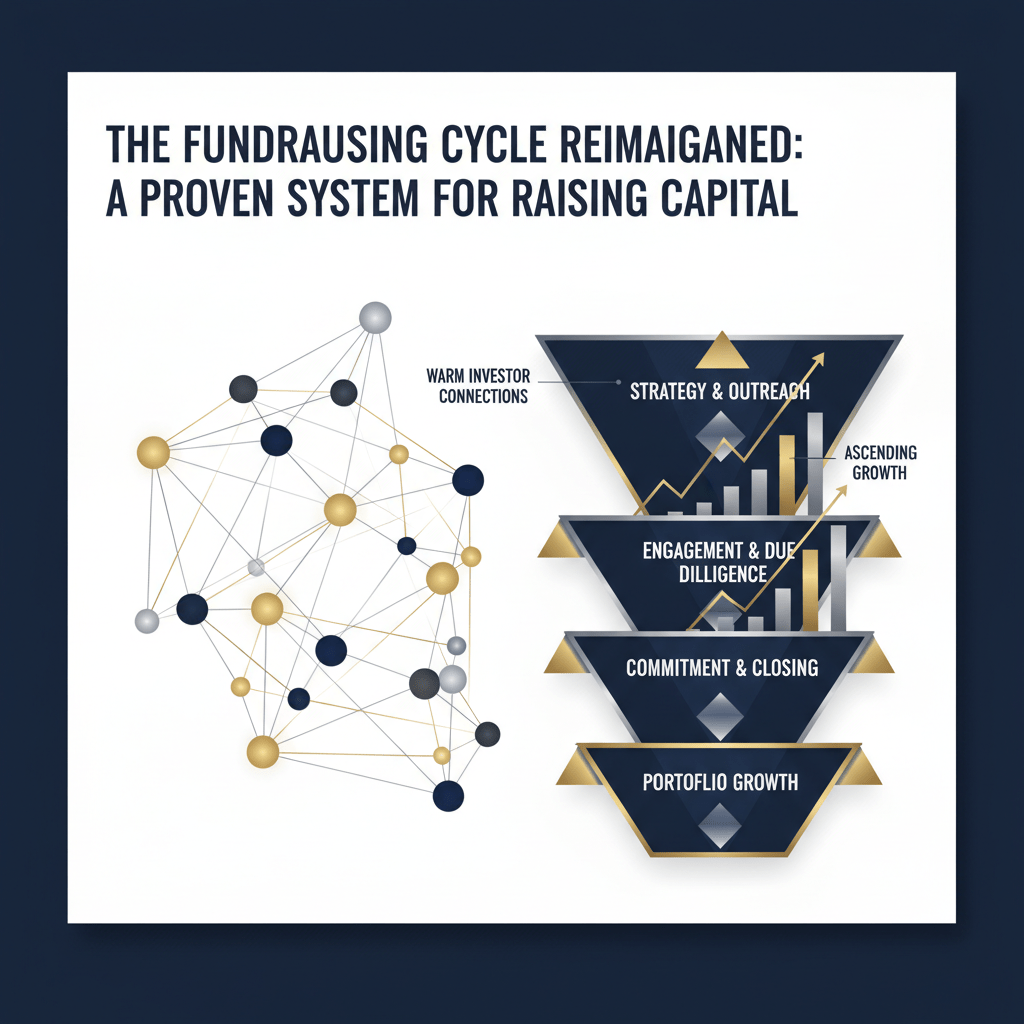
The fundraising cycle is a strategic, multi-stage process guiding founders from identifying potential investors to closing a funding round and managing post-investment relationships. Unlike traditional models, a modern, effective cycle prioritizes relationship-based fundraising and warm introductions over cold outreach to secure capital more efficiently.
Raising money often feels like a painful cycle of cold outreach and rejection. The traditional approach, with its generic pitches and limited access to serious investors, makes it hard to raise capital effectively. If you are tired of this struggle, you need a better strategy to get the funding your vision deserves. A proven system can turn this chaotic process into a reliable growth plan by focusing on quality connections over quantity.
This article introduces a smarter, relationship based fundraising approach. At Gild Members, we teach a system for building a strong private investor network. Success comes from good investor relations and warm introductions, which turns outreach from a gamble into a smart move. This is about more than securing funds. It’s about profiting from your network and building lasting, high-value relationships in an exclusive community.
This guide explains the typical fundraising cycle and why most founders get the critical stages wrong. You will discover how the Investment Rainmaker training system helps you move from constant rejection to a powerful, relationship first capital raising strategy. You will learn to build and profit from a global investor network, giving you access to exclusive introductions and better capital. Let’s begin by looking at the traditional fundraising process and its pitfalls.
What Is the Fundraising Cycle (And Why Do Most Founders Get It Wrong)?
Fundraising is not just a list of separate tasks. It is a smart cycle. It covers everything from meeting investors to working with them after they invest. But most founders get it wrong. They treat fundraising like a messy, one-time event. This leads to rejection and wasted time. Many do not have a system that works for building an investor network.
Old ways of fundraising often fail for a few key reasons:
- Relying on Cold Outreach: Founders often contact strangers. They send emails or make calls to people they don’t know. This method has a very low success rate [1]. It pushes potential investors away.
- Not Building Relationships: They focus on asking for money too soon. Founders forget to build real connections. Wealthy investors value trust and a good relationship most of all.
- Failing to Build Interest: Many founders do not build investor interest over time. They pitch their idea right away. This skips key steps for growing a real investor network.
- Ignoring Investors After Funding: The work often stops once money is raised. However, true Investment Rainmakers understand taking care of investors is key. This makes future fundraising much easier.
- No Proven System to Raise Capital: Founders work without a clear plan. They lack practical fundraising training. This leads to unpredictable results and burnout. They find it hard to raise money well.
This messy approach makes founders tired of rejection. They struggle to find only serious investors. They also miss chances to earn money from their networks. Without a clear system, building a valuable investor network is out of reach. This is where the GILD approach changes the fundraising cycle.
GILD members know that good fundraising is not about contacting everyone. They focus on quality investors, not quantity. We offer a private community for those ready to master working with investors. We focus on warm introductions and putting relationships first. This changes you from someone who struggles to raise capital into an Investment Rainmaker.
What are the 6 stages of the fundraising cycle?

Stage 1: Prospect Identification & Research (Building Your High-Value Investor List)
Every successful capital raise starts with finding the right prospects. This first step is more than just mass outreach. It focuses on building a select list of potential investors. We focus on quality over quantity investors. This approach helps you avoid constant rejection. A good capital raising strategy begins with understanding your ideal investor. This includes their investment goals, past deals, and current focus.
Effective investor network building requires precision. You need to find qualified members for your high net worth investor network. These are the people most likely to believe in your vision. The process is about making a strategic match. You look for investors whose interests align with your business. Many founders struggle to raise capital because they skip this key step. They cast a wide net and hope for the best. However, the Investment Rainmaker system teaches a more focused way. It is about building a high-value investor list from the start. This makes sure every conversation you have is worthwhile.
Stage 2: Cultivation (The Art of Relationship-Based Fundraising)
Cultivation is the heart of relationship based fundraising. This stage turns prospects into people who are truly interested. It’s not about asking for money right away. Instead, it focuses on building a connection and trust. You build a real relationship over time. This process greatly reduces the chance of investor rejection.
The core of this stage is smart engagement. This includes sharing valuable information and showing steady progress. You teach potential investors about your vision and your market. This builds a foundation of shared understanding. GILD’s investor relations training teaches this important skill. We go beyond basic networking. Our method focuses on creating warm investor introductions. We do this by building connections within your private investor network. The goal is to effectively monetise investor network potential. To become an Investment Rainmaker, you must master this skill. It helps you build investor relationships that work. This removes the need for tiring cold outreach strategies. Instead, you build a powerful, exclusive investor community around your business.
Stage 3: The Strategic Ask (Moving Beyond the Cold Pitch)
The strategic ask is the final step after building a relationship. This is when you present your investment opportunity. But it’s completely different from a cold pitch. At this point, the investor already sees your value. They are already interested in your business. Your ask feels like a natural next step. It’s an invitation to partner, not a desperate request.
A proven system to raise capital depends on perfect timing. You make your ask when the relationship is strong. Also, your investor pitch strategies must be short and powerful. Focus on the value you offer. Clearly explain the market opportunity and showcase your team’s strengths. This helps you attract serious investors only. The GILD membership program offers full support with our investor pitch training program. We help you create an ask that connects with investors. This method turns struggling to raise capital into creating successful capital raising strategies. It shows our core belief in relationship-first fundraising. This method avoids the problems of cold outreach.
Stage 4: Negotiation & Due Diligence (Securing Favorable Terms)
Negotiation begins once an investor shows serious interest. This key stage is about agreeing on the investment terms. It requires smart thinking and clear communication. Your goal is to get good terms for your business. This protects your ownership and future growth.
Due diligence is a two-way street. Investors will check your finances, legal papers, and business plan. At the same time, you should check the investor’s background. This ensures you are a good fit and can build trust. A proven system to raise capital gets you ready for this close review. GILD shows you common mistakes to avoid in negotiations. We also teach you the best ways to handle due diligence. This is very important for global capital raising strategies. You must understand international laws and investor expectations. Our practical fundraising training makes sure you are ready. It helps you raise capital effectively, with confidence, and on your own terms.
Stage 5: Closing the round (Finalizing the Investment)
Closing the round is the final step in the investment process. It includes legal paperwork and the transfer of funds. Attention to detail is crucial here. Every agreement must be exact and legally correct. This protects everyone involved.
This stage requires careful planning. You will work with lawyers to finalize all agreements. These include term sheets, subscription agreements, and shareholder agreements. A successful capital raising strategy ends with a smooth closing. Many founders find this part scary. However, GILD’s elite capital raising course makes it simple. We teach a proven system to raise capital that makes this process easier. Our approach ensures you can raise capital effectively. You go from struggling to raise capital to successfully getting funds. This lets you focus on growing your business with the new money.
Stage 6: Stewardship (Mastering Investor Relations Post-Investment)
Stewardship after you get the money is often overlooked, but it is essential. It means actively managing your relationships with investors. This is how you truly monetise investor network potential. Good stewardship builds lasting trust and loyalty. It also opens the door for future funding.
This stage means communicating regularly. Give regular updates on your business progress and key achievements. Be open about your challenges and your wins. Also, ask for your investors’ advice and support. They are now your partners. GILD’s investor relations training gets you ready for this long-term relationship. It reinforces the ideas of relationship based fundraising. When you master this stage, you become an Investment Rainmaker. You build a valuable, exclusive investor community. This turns fundraising into an ongoing cycle of shared growth. Your private investor network becomes a powerful tool for long-term success.
How to Break the Traditional Cycle with the GILD Method

Focusing on Warm Introductions, Not Cold Outreach
Fundraising often means endless cold outreach. This leads to high rejection rates and frustration. Founders waste valuable time and resources.
GILD offers a better way. We believe in fundraising through relationships. Our goal is to get you warm investor introductions. This connects you directly with serious private investors. You can stop struggling with old, ineffective methods.
With GILD, you get access to an exclusive investor community. This network provides a steady stream of pre-qualified investor contacts. You avoid the problems of mass outreach. Instead, you build real relationships that lead to funding. As a result, your fundraising becomes much more effective. Warm introductions are the key to raising capital.
- Get targeted, warm introductions to investors.
- Stop wasting time on cold pitching.
- Connect with accredited and sophisticated investors.
- Build a trusted network of private investors.
- Raise your fundraising success rate.
Building a Monetizable Private Investor Network
Many founders build networks with no clear plan. They collect contacts but struggle to turn them into funding. GILD changes how you build your network. We teach you how to grow your network and turn it into capital. It’s more than just collecting business cards.
Our method helps you build a network of high-net-worth investors. This network becomes a valuable asset. It gives you steady access to private capital and new deals. You will learn the best ways to manage investor relations. This is key for long-term success. GILD membership also gives you direct access to our global investor network. This opens doors to funding from around the world.
The GILD system makes sure your network delivers results. You learn to find, connect with, and turn contacts into investors. This is a core part of our training. You will build valuable investor connections that last a lifetime. This is vital for any ambitious founder.
- Learn to turn your network into capital.
- Build a strong network of high-net-worth investors.
- Gain exclusive access to sophisticated and accredited investors.
- Turn your current contacts into sources of funding.
- Get steady deal flow and global funding opportunities.
Implementing the Proven ‘Investment Rainmaker’ System
Most fundraising methods lack a proven system. This leaves founders guessing and hoping for results. GILD introduces the ‘Investment Rainmaker’ system. It is a complete, step-by-step method designed to help you raise capital successfully.
Becoming an Investment Rainmaker means mastering fundraising through relationships. You learn to attract capital again and again. The system is based on practical, real-world training. You will go from random attempts to a steady flow of investor interest. Our training gives you a clear roadmap. It covers everything from finding investors to closing the deal. You get a real advantage over the competition.
This proven system is only for GILD members. It combines expert training with our private investor community. You get personal guidance and support. This helps you confidently handle tough fundraising talks. It’s not just a course; it’s a change in how you work. You become a leader who attracts capital with ease.
- Use the Investment Rainmaker system to raise capital consistently.
- Follow a proven system to build your investor network.
- Learn to raise funds through relationships with hands-on training.
- Get access to exclusive fundraising masterclasses.
- Earn your Investment Rainmaker certification to show your expert status.
How Can You Create a Fundraising Cycle Template That Works?

Key Components of a Successful Capital Raising Plan
A great capital raising plan is much more than a pitch deck [2]. It needs a clear, strategic approach. This helps you attract serious investors and build lasting relationships, not just get one-time funding. Forget cold calls; our focus is on fundraising through proven relationships.
Here are the key parts of a successful plan:
- Strategic Investor Targeting: Find and research private investors who fit your vision and industry. This goes beyond generic lists to build a high-net-worth investor network of people who are truly interested. Quality over quantity leads to warm investor introductions.
- Relationship-First Engagement: Create a plan to build real connections. This is the key to building an effective investor network. It turns first meetings into a trusted private investor network through steady, valuable contact.
- Compelling Narrative and Vision: Share your investment opportunity clearly and with passion. Your story must connect with investors, showing your potential for growth and unique value. This is vital for grabbing the interest of a high-net-worth investor network.
- Robust Due Diligence Preparation: Be ready for tough questions. Organize all your financial, legal, and company documents with care. Being prepared saves time, builds investor confidence, and shows you are professional.
- Post-Investment Investor Relations: Plan how you will communicate after a deal closes. Good investor relations training isn’t just about securing capital. It’s about preparing for future funding and long-term partnerships.
Using these elements gives you a proven system to raise capital. It ends the frustration of investor rejection. It also helps you become an Investment Rainmaker, skilled at global capital raising and creating profitable investor connections.
Tools for Managing Investor Relationships Effectively
Good investor relations are key for raising capital and getting value from your network. Managing these relationships can be hard. However, using the right tools turns this challenge into a major advantage. This approach helps you engage with your exclusive investor community in a meaningful way.
Consider these essential tools and practices to master your investor network:
- Specialised CRM for Investor Relations: Use a Customer Relationship Management (CRM) system designed for investors. It can track every conversation, preference, and commitment. This gives you a complete view of your entire private investor network.
- Strategic Communication Protocols: Set up a clear communication plan. This should include regular updates, personal outreach, and quick replies. Consistent, quality communication is vital for relationship-based fundraising and keeping your high-net-worth investor network engaged.
- Performance Tracking and Reporting: Track key numbers on investor engagement and fundraising progress. Detailed reports help you improve your capital raising strategies. They also show transparency and professionalism to your exclusive investor community.
- GILD’s Network Monetization Framework: Use a structured plan to get value from your investor network. GILD provides frameworks to find and act on opportunities within your relationships. This approach turns passive contacts into active, profitable partnerships.
These tools, along with expert investor relations training, provide the proven system you need. They are critical for founders who find it hard to raise capital. With this approach, you get warm investor introductions and build investor relationships that work. This allows you to access a global network of investors and secure your position as an Investment Rainmaker.
Frequently Asked Questions
What are the 6 stages of the fundraising cycle?
The typical fundraising cycle has six stages. But for many founders, the old way leads to rejection and poor results. At GILD, we teach a new, more effective approach.
These six stages are:
- Prospect Identification & Research: This stage is about finding investors. Most people use huge, generic lists. Instead, we teach you how to build a smaller, high-value private investor network.
- Cultivation: This is about connecting with potential investors. Old methods use cold outreach. We teach relationship based fundraising to get warm introductions.
- The Strategic Ask: This is when you ask for the investment. A generic pitch is not enough. Our investment rainmaker training shows you how to make your pitch strategic and powerful.
- Negotiation & Due Diligence: Here, you agree on terms and verify all the details. A strong relationship makes this process much smoother.
- Closing the Round: This is the final step to secure the investment. Our proven system helps you get a great outcome.
- Stewardship: This means managing relationships after the investment. It is key for raising more money later. Good stewardship helps you grow your monetisable investor network.
Knowing these stages is just the first step. GILD is different because we change each stage into a path for successful capital raising strategies. [3]
What are the fundraising cycle steps?
The steps in the fundraising cycle are the same as the stages above. Founders need to master these steps with a proven system. GILD helps you manage each step with confidence:
- Identifying Prospects: Don’t use generic lists. GILD helps you with investor network building. We focus on creating high net worth investor networks for quality, not quantity.
- Cultivating Relationships: GILD is great at this step. We teach capital raising without cold pitching. Our method focuses on warm investor introductions and real connections. You will build investor relationships that get results.
- Making the Strategic Ask: Stop struggling to raise capital the old way. We offer an expert investor pitch training program. It uses the relationships you have already built to get real interest, not rejection.
- Negotiating Terms: Good relationships lead to fairer negotiations. Our elite capital raising course gives you the confidence to get the best possible terms.
- Closing the Investment: With GILD, you use a proven system to raise capital. This makes the closing process smooth. You will work only with serious investors.
- Post-Investment Stewardship: Real investor relations training continues after you close the deal. GILD teaches you how to monetise your investor network for the long term. This builds a powerful private investor network for future growth.
These new steps are the core of our Investment Rainmaker system. They are a major change in global capital raising strategies.
How is the fundraising cycle different for nonprofits?
Building relationships is always important. But the fundraising cycle for nonprofits is very different from capital raising for business. Nonprofits raise money through donations and grants. They don’t sell parts of their company. Their goal is to make an impact, not a financial return for investors.
Key differences include:
- Motivation for Giving: People give to nonprofits to support a good cause. People invest in businesses to make money.
- Types of Donors/Investors: Nonprofits engage individual donors, foundations, and government grants. Businesses target venture capitalists, angel investors, family offices, and other private investors.
- The “Ask”: Nonprofits ask for donations to support their mission. Businesses ask for money in return for a part of the company.
- Return on Investment: Nonprofits offer social returns and impact. Businesses offer financial returns.
However, GILD’s methods can still help nonprofits. Our focus on relationship based fundraising is valuable for any group that needs to raise money. It is always important to understand donors, build relationships, and maintain them [4]. The core ideas from our investor relations training can help build trust and improve any fundraising effort.
Sources
- https://www.forbes.com/sites/startupnationcentral/2023/10/26/why-cold-outreach-isnt-working-for-startups-and-what-to-do-instead/
- https://www.investopedia.com/terms/c/capital-raise.asp
- https://www.investopedia.com/terms/f/fundraising.asp
- https://www.councilofnonprofits.org/tools-resources/fundraising-strategies
To connect each stage of this cycle with readiness checks, investor targeting, evidence, and closing tasks, visit the GILD capital raising resource center.